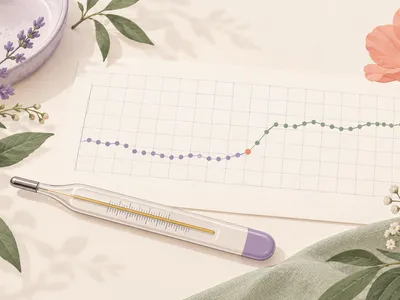
Watches and rings that track temperature at night can show patterns across a menstrual cycle. That interests people trying to conceive, but “predicting ovulation” can mean two different tasks: flagging potentially fertile days in advance or estimating afterward when ovulation probably happened. The distinction changes how useful the result is. An attractive graph does not confirm that an egg was released, and a validated algorithm for one device does not validate every sensor on the market.
What a wrist sensor measures
A wearable may collect wrist skin temperature, heart rate, and other physiological signals during sleep. It does not measure LH directly, view the follicle, or detect an egg. Progesterone can raise temperature after ovulation, so a sustained shift may help distinguish cycle phases. Broken sleep, illness, alcohol, room temperature, and wearing habits can affect readings. Even when a sensor collects many data points, interpretation depends on the algorithm and the population used to test it.
Looking back is different from looking ahead
A retrospective method examines a sequence of temperatures and identifies a likely ovulation day that has passed. That may help explain a cycle, but it arrives too late for some timing decisions in the same month. A prospective method attempts to flag fertile days before the complete pattern appears. Here, an error of several days can matter. Neither method replaces a clinical assessment when cycles are very irregular, periods stop, or conception remains difficult.
What a bracelet validation study found
Niggli and colleagues followed 61 clinical participants over 205 cycles and compared bracelet algorithms with urinary ovulation tests. Under the researchers’ prespecified limits, retrospective and prospective approaches correctly identified about three quarters of fertile days. The paper also examined real-world users, but the clinical participants were not receiving current hormonal therapy. Authors linked to the manufacturer were involved, which is relevant context. Performance for one bracelet cannot be assumed for every watch [1].
What other studies add
Goodale and colleagues observed menstrual changes in physiology and the potential to estimate a fertile window using sensors in an observational study of a specific device [2]. In a 2025 cohort, Wang and colleagues assessed wrist-temperature algorithms using data from 260 participants and 889 analyzed cycles. Among cycles with a defined minimum temperature signal, one retrospective algorithm produced an ovulation-day estimate in about 80% of cycles, with a mean absolute error near 1.6 days. The authors warn that a false retrospective estimate is possible when ovulation did not occur [3].
Why a study average is not a personal promise
The studies use different participants, devices, inclusion rules, and outcomes. Some define ovulation by a urinary LH surge, a useful marker that does not directly show follicle rupture. Results in cycles with a clearer temperature signal may exceed what a person with missing data or highly variable cycles experiences. Average accuracy in a sample cannot tell an individual the precise error for their next cycle. Nor does identifying a window by itself prove a higher pregnancy rate.
When to combine other records
When trying to conceive, it can help to view period dates alongside cervical mucus observations, urinary LH tests, and symptoms. Each offers a different clue; a disagreement is not resolved by picking the most confident graph. If a device marks one day and a test suggests another, record both and discuss a recurring pattern with a clinician. The team can determine whether hormone testing, ultrasound, or another investigation is needed.
How Levvi helps: an example cycle
In Levvi, record period days, flow, cervical mucus, symptoms, basal body temperature when measured, sleep, and ovulation-test results. For example, a bracelet shows a temperature rise on day 16, while an LH test was positive on day 14. Keep both dates and the sleep context instead of declaring that ovulation definitely occurred on either day. At a visit, that timeline is more useful than one screenshot. Levvi estimates a fertile window from records; it does not automatically import or validate every watch and cannot diagnose anovulation.
Common questions
- Is wrist temperature the same as basal body temperature? No; measurement sites and methods differ.
- Does a watch confirm ovulation? No. A temperature pattern is indirect and may mislead in an anovulatory cycle.
- Is a calendar alone enough? It estimates dates and can be wrong when cycle lengths vary.
- Do more data always mean more accuracy? No. Data quality, consistent use, and algorithm validation also matter.
Conclusion
Wrist sensors show promising results for describing menstrual patterns and estimating the periovulatory period in the devices studied [1][2][3]. Interpretation remains essential: looking back differs from prediction, every estimate has an error margin, and reference tests have limits too. Use Levvi to organize the clues and bring persistent questions to clinical care rather than treating an app number as proof of ovulation.