
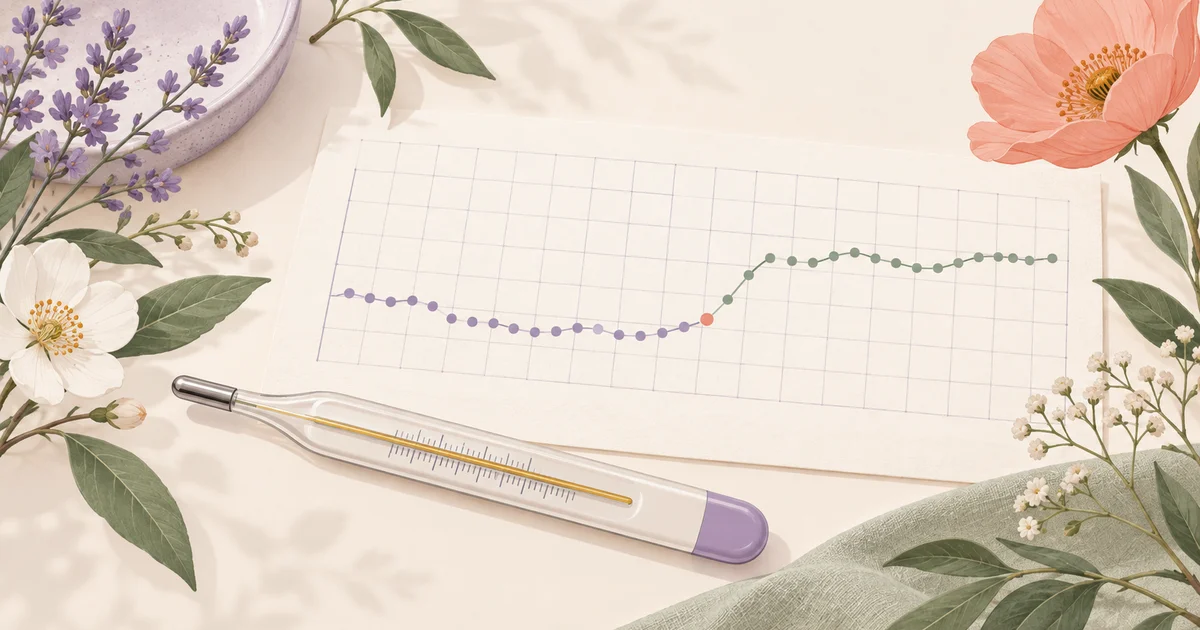
You wake up, reach for the thermometer before even sitting up, and log: 36.4°C. Tomorrow, 0.1°C higher. The day after, 36.7°C. Suddenly, that chart that looked like a mess of numbers starts telling a story — the story of your cycle, written in tenths of a degree. Basal body temperature is one of the oldest and most studied tools in reproductive planning, and understanding how it works can transform your trying-to-conceive journey.
What basal body temperature is and why it changes
Basal body temperature (BBT) is your body's resting temperature — measured before any physical activity, before eating, before speaking. During the follicular phase it stays between 36.1°C and 36.4°C. Right after ovulation, progesterone secreted by the corpus luteum raises that temperature by 0.2 to 0.5°C, and it stays elevated throughout the entire luteal phase [1]. This thermal shift is the most reliable sign that ovulation happened. Research confirms that temperature remains above the pre-ovulatory baseline for 12 to 16 days in healthy, ovulatory cycles [4]. If your period doesn't arrive and temperature stays high for more than 18 consecutive days, that can be an early sign of pregnancy. Levvi logs basal body temperature alongside other cycle data — flow, cervical mucus, symptoms — so you can track patterns over months and arrive at medical appointments with concrete data in hand.
How to measure basal body temperature correctly
Measuring BBT correctly is what separates a useful chart from a series of random numbers. The most important rule: measure before getting out of bed, after at least 3 hours of uninterrupted sleep, at the same time every day. A variation of just 30 minutes in measurement time can shift the result by 0.1°C — enough to throw off the whole chart [3]. Use a digital basal thermometer with 0.05°C or 0.1°C precision — standard fever thermometers are not accurate enough. The oral route (under the tongue for 5 minutes) is the most practical. Leave the thermometer on your nightstand before you sleep. Factors that can artificially raise temperature include: alcohol the night before, fever, disrupted sleep, travel, and intense stress. Note those days in your log so you don't misread an outlier as an ovulation signal. Set a daily reminder in Levvi for the time you typically wake up — consistency of timing matters more than the exact hour.
The BBT chart: coverline and identifying ovulation
The coverline is the horizontal line that divides a BBT chart into two territories: pre-ovulatory temperatures (below) and post-ovulatory temperatures (above). To calculate it, find the highest temperature among the 6 days before the first temperature rise, then add 0.1°C. Ovulation is confirmed when you have 3 consecutive temperatures above the coverline [2]. The classic pattern shows stable temperatures in the follicular phase, sometimes a sharp dip on ovulation day (not always present), followed by a sustained rise. Important: BBT confirms ovulation happened but gives no advance warning — the luteal phase has already begun when the chart rises. That's why, for women trying to conceive, BBT is best used as a pattern-learning tool over 2 to 3 cycles [1]. With that history, you start to predict which day of your cycle ovulation typically occurs.
The fertile window: when to plan intercourse
The fertile window lasts on average 6 days: the 5 days before ovulation and ovulation day itself. The egg survives only 12 to 24 hours, but sperm can survive in the reproductive tract for up to 5 days [1]. This means having intercourse 2 to 3 days before ovulation is often as effective as on ovulation day itself. Because BBT only confirms ovulation retrospectively, the strategy for women using this method alone is: after 2 to 3 cycles of logging, you know which days ovulation tends to occur and plan intercourse for the days before. Ovulation trackers that rely solely on temperature miss the most fertile window — which is why experts recommend combining BBT with at least one other body sign [2]. Levvi displays your predicted fertility window and counts cycle days in real time, making that planning straightforward.
BBT and cervical mucus: the sympto-thermal method
The sympto-thermal method combines basal body temperature with cervical mucus observation — and is significantly more accurate than either signal alone [3]. Cervical mucus provides advance notice: as estrogen rises before ovulation, mucus changes from dry or sticky to creamy, then watery, and at the fertile peak to egg-white consistency — clear, stretchy, slippery. That mucus signals ovulation is approaching or occurring and creates the ideal environment for sperm. When basal temperature rises and mucus begins to dry again, ovulation is confirmed and the fertile window has closed. A 2024 study confirmed that BBT alone fails to pinpoint the exact ovulation day, detecting the temperature rise only 1 to 2 days after it occurred [2]. Levvi lets you log cervical mucus type daily — dry, sticky, creamy, watery, or egg-white — exactly what the sympto-thermal method requires.
What the luteal phase reveals about your fertility
The luteal phase — the period between ovulation and menstruation — is a valuable window of information about reproductive health. A healthy luteal phase lasts between 12 and 16 days [4]. Luteal phases shorter than 10 days can indicate progesterone deficiency — a condition associated with difficulty in embryo implantation and present in a subset of unexplained infertility cases. The American Society for Reproductive Medicine recognizes luteal phase deficiency as a clinically relevant factor, though diagnosis requires more than BBT alone [4]. On the BBT chart, this appears as an elevation lasting fewer than 10 days before dropping and menstruation beginning. If you notice this pattern across 2 or more consecutive cycles, it is worth discussing with a gynecologist. One of the greatest benefits of logging BBT over several months is exactly this: you arrive at a medical consultation with concrete data, not just symptoms.
Chart patterns that deserve attention
Not every BBT chart is textbook — and understanding atypical patterns can guide important conversations with your doctor. An anovulatory cycle (no ovulation) appears as a flat or erratic temperature line with no clear biphasic shift. This can happen occasionally in any woman due to stress, illness, or travel, but when it repeats for 2 to 3 consecutive cycles it warrants investigation [1]. A slow, gradual rise instead of an abrupt one may indicate delayed ovulation or lower progesterone levels. Pre-ovulatory temperatures consistently above 36.7°C can be a sign of hypothyroidism — a condition affecting up to 10% of women of reproductive age that directly interferes with fertility. Research on a validated BBT measurement device tested in 20 women found that pre-ovulatory temperature stays below 36.5°C and post-ovulatory temperature falls between 36.5°C and 37°C [5]. Levvi stores your full temperature history across cycles, letting you compare months and catch variations that would go unnoticed in isolation.
How to start: a practical routine for your first 30 days
To make the BBT chart useful, you need at least one complete cycle of data — and two or three cycles reveal patterns far more clearly. Set a daily reminder in Levvi for the time you typically wake up, and leave your thermometer on your nightstand every night. Log as soon as you wake up, before any movement. In the first few days temperatures may look random — that is normal. Note days when something unusual happened (poor sleep, alcohol, illness) to flag outliers. After the first cycle you can draw an approximate coverline. After the second, the biphasic pattern begins to repeat and you identify your typical ovulation day. Research shows that tracking ovulation reduces average time to conception in couples with no known reproductive issues [1]. BBT is a powerful self-knowledge tool — and 5 minutes of consistency each morning can make a real difference in your journey.