That tightness in your chest, racing heart, and feeling that everything is too much? This is not weakness — it is your nervous system doing exactly what it was designed to do: protect you from perceived threat.[1] The problem is that for many women today, this protection system runs almost continuously, responding to work pressure, mental load, and chronic stress as if they were physical dangers. Understanding how your nervous system works is the first step toward reclaiming a genuine sense of calm — and Levvi can help you track the daily habits that make the biggest difference.
The Autonomic Nervous System: Your Body's Autopilot
The autonomic nervous system (ANS) is your body's autopilot — a network that controls functions you never consciously think about: heart rate, digestion, blood pressure, and breathing.[1] It operates in two primary modes: the sympathetic system (fight-or-flight), which mobilizes energy for action, and the parasympathetic system (rest-and-digest), which promotes recovery, calm, and connection. Both systems are essential and healthy — the problem is when they fall out of balance. Research shows that chronic stress can shift the baseline toward sustained sympathetic dominance, making calm feel physically inaccessible even in objectively safe environments.
When sympathetic activation becomes chronic, the body pays a measurable price: elevated heart rate variability decline, disrupted digestion, compromised immune function, and impaired sleep quality.[2] Muscle tension becomes the default state rather than the exception. The nervous system that was designed to switch rapidly between alert and calm gets stuck in alert mode. Recognizing this as a physiological state rather than a character trait is important — it means it can be changed with consistent, targeted practice rather than willpower alone.
The Polyvagal Theory: 3 States of Your Nervous System
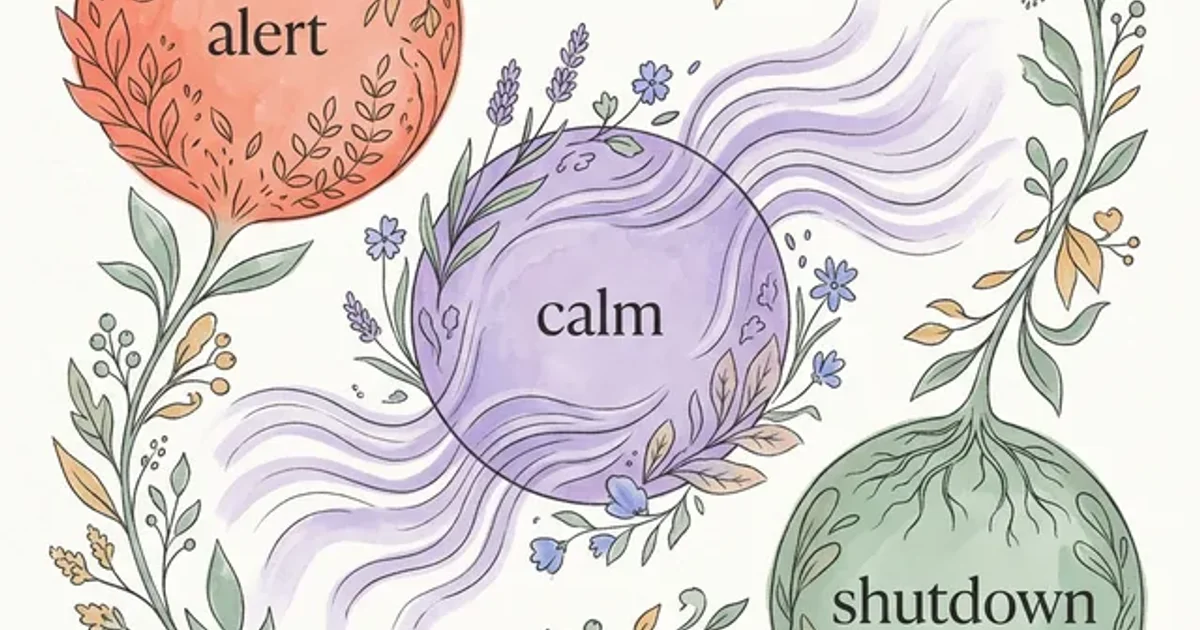
The Polyvagal Theory, developed by neuroscientist Stephen Porges, offers a more nuanced map of how our nervous system actually functions.[1] Rather than just two modes — on and off — it describes 3 distinct states that the nervous system cycles through, each with a different physiological signature and behavioral profile. Understanding which state you are in at any given moment helps you choose the most effective regulation strategy rather than applying the same technique regardless of context.
- Ventral vagal (safety): you feel calm, present, and socially connected. Breathing is relaxed, digestion works well, and you can think clearly. This is the optimal state for creativity, learning, and relationships.
- Sympathetic (fight-or-flight): activated when a threat is perceived. Heart rate rises, muscles tense, digestion pauses, and attention narrows to the threat. Designed for short-term bursts, not sustained daily operation.
- Dorsal vagal (shutdown): when threat feels inescapable, the system shuts down. This produces extreme fatigue, emotional numbness, disconnection, and the feeling of being 'frozen' or 'checked out' from life.
According to Porges, the key to emotional regulation is the vagus nerve — the longest nerve in the parasympathetic system, connecting the brain directly to the heart, lungs, and intestines.[1] The ventral branch of the vagus nerve is specifically associated with the social engagement system — the calm, connected state. Practices that directly stimulate this nerve pathway can shift the nervous system from sympathetic activation back toward the ventral vagal state within minutes, offering a physiological pathway to genuine calm rather than just cognitive reassurance.
Why Women Are More Vulnerable to Dysregulation
Reproductive hormones — estrogen and progesterone — interact directly with the autonomic nervous system.[3] During the luteal phase of the menstrual cycle, when estrogen drops after ovulation, vagal tone can decrease, making the sympathetic state more easily triggered and harder to exit. Research shows that heart rate variability — a key marker of vagal tone and stress resilience — fluctuates measurably across the menstrual cycle in women. This means that nervous system dysregulation is not equally likely at all points in the month: it peaks during specific hormonal windows, particularly in the late luteal phase before menstruation.
Beyond hormonal fluctuations, women frequently carry an invisible mental load — the simultaneous management of work, household, relationships, children, and self-care that never fully switches off.[3] This chronic cognitive overload maintains low-grade sympathetic activation as a near-constant background state. Studies show that perceived uncontrollability of stressors — a common experience for women managing multiple competing demands — is one of the strongest predictors of sustained HPA axis activation and nervous system dysregulation over time.
Practices That Activate the Vagus Nerve
The vagus nerve can be directly stimulated through specific behaviors — a finding supported by growing research on what is called vagal tone training.[2] Higher vagal tone is associated with faster recovery from stress, better emotional regulation, improved heart rate variability, and lower inflammatory markers. Studies show that consistent contemplative practices can significantly increase vagal tone over 8 to 12 weeks. Levvi's daily habit tracking helps you build these practices consistently rather than turning to them only in moments of crisis.
- Slow, extended breathing: breathing at roughly 6 breaths per minute — especially with the exhale longer than the inhale — directly activates the vagus nerve and shifts the ANS toward parasympathetic dominance within 2 to 3 minutes.
- Humming and singing: the vibration produced by humming or vocalizing stimulates the vagus nerve at the throat. Even 5 minutes of humming or gentle singing produces measurable effects on heart rate variability.
- Cold water exposure: splashing cold water on the face or ending a shower with 30 seconds of cold water activates the dive reflex, which rapidly stimulates the parasympathetic system and lowers heart rate.
- Intentional silence: a systematic review found that periods of intentional silence — even 5 to 10 minutes without sound input — produce measurable calming effects on the nervous system distinct from active relaxation techniques.
- Mindful movement practices: yoga, tai chi, and qigong combine movement, breathing, and focused attention in ways that have been shown to increase vagal tone and reduce sympathetic baseline activation over 8 to 12 weeks of consistent practice.
Signs Your Nervous System Needs Attention
Dysregulation does not always look like obvious panic or anxiety. Many women spend months or years in a state of chronic low-grade sympathetic activation without recognizing it as a nervous system problem. These signals suggest your system may need more consistent regulation practices:
- Difficulty relaxing even in objectively safe environments — feeling unable to 'switch off' even at home or on weekends.
- Disproportionate emotional reactions to minor everyday situations — snapping at small frustrations or feeling overwhelmed by routine demands.
- Constant muscle tension, especially in the jaw, shoulders, and neck — the body's physical signature of sustained sympathetic activation.
- Recurrent digestive issues without a medical cause — the gut is directly regulated by the vagus nerve and responds immediately to ANS state.
- Extreme fatigue or feeling 'checked out' from the world — dorsal vagal shutdown presenting as exhaustion and disconnection.
- Sleep that does not restore energy — sleeping enough hours but waking feeling unrefreshed, suggesting nervous system hyperarousal during sleep.
- Frequent feeling of being in 'survival mode' — managing rather than living, with no sense of ease or presence in daily life.
If several of these patterns resonate, your nervous system likely needs more consistent regulation practices throughout the day — not just stress management in crisis moments. Tracking how you feel across your cycle in Levvi can reveal when your nervous system is most vulnerable and which practices actually help.
Evidence-Based Daily Practices
Incorporating nervous system regulation into your daily routine does not require dramatic changes.[2] Research shows that small, consistent practices compound over time to produce lasting shifts in baseline vagal tone and stress resilience. Start with 2 to 3 of these and build from there using Levvi's habit tracker to maintain consistency:
- Start your day with 2 minutes of slow breathing: inhale for 4 seconds, exhale for 6. This morning practice signals safety to your nervous system before the demands of the day begin.
- Include intentional silence throughout the day: even 5 minutes without sound input — no music, podcasts, or notifications — measurably reduces sympathetic activation.
- Breathe before reacting: when you feel an intense emotional reaction building, take 3 long exhalations before responding. This interrupts the sympathetic activation cycle and restores prefrontal cortex access.
- Track your patterns across the cycle: note how you feel in different phases. Knowing that dysregulation tends to increase in the late luteal phase helps you schedule lighter demands and more regulation practices during that window.
- End your shower with 30 seconds of cold water: the thermal shock activates the dive reflex, training your nervous system's recovery speed over time.
- Practice mindful movement regularly: yoga, nature walks, or stretching with breath awareness are among the highest-evidence practices for building sustainable vagal tone.
Frequently Asked Questions
What is vagal tone and why does it matter?
Vagal tone is a measure of how active and efficient your vagus nerve is.[1] High vagal tone means your nervous system can recover quickly after stressful situations — you return to calm faster and with less residual activation. It is associated with better emotional regulation, lower baseline inflammation, and improved heart rate variability. Vagal tone is not fixed: research shows it can be measurably increased through consistent practices like slow breathing, mindful movement, cold exposure, and even humming — with improvements detectable in as little as 8 weeks.
Is nervous system dysregulation the same as anxiety?
Not exactly. Anxiety is an emotional and cognitive experience that can have multiple causes.[1] Nervous system dysregulation is one physiological foundation that can contribute to anxiety symptoms — but dysregulation can also present as fatigue, digestive problems, emotional numbness, or hyperreactivity without meeting clinical criteria for an anxiety disorder. Addressing dysregulation directly through vagal tone practices can reduce anxiety symptoms even in people who would not describe themselves as anxious — because it works at the physiological level rather than the cognitive level alone.
How long before nervous system practices produce noticeable effects?
Some effects are immediate — a session of slow breathing can reduce heart rate within 2 to 3 minutes.[2] Deeper benefits, like increased baseline vagal tone and greater stress resilience, typically require 8 to 12 weeks of consistent daily practice. This is because nervous system change involves gradual neuroplasticity rather than a quick fix. Tracking your daily practices in Levvi makes it easier to stay consistent long enough to experience these deeper, lasting shifts — rather than abandoning practices before they have time to work.