
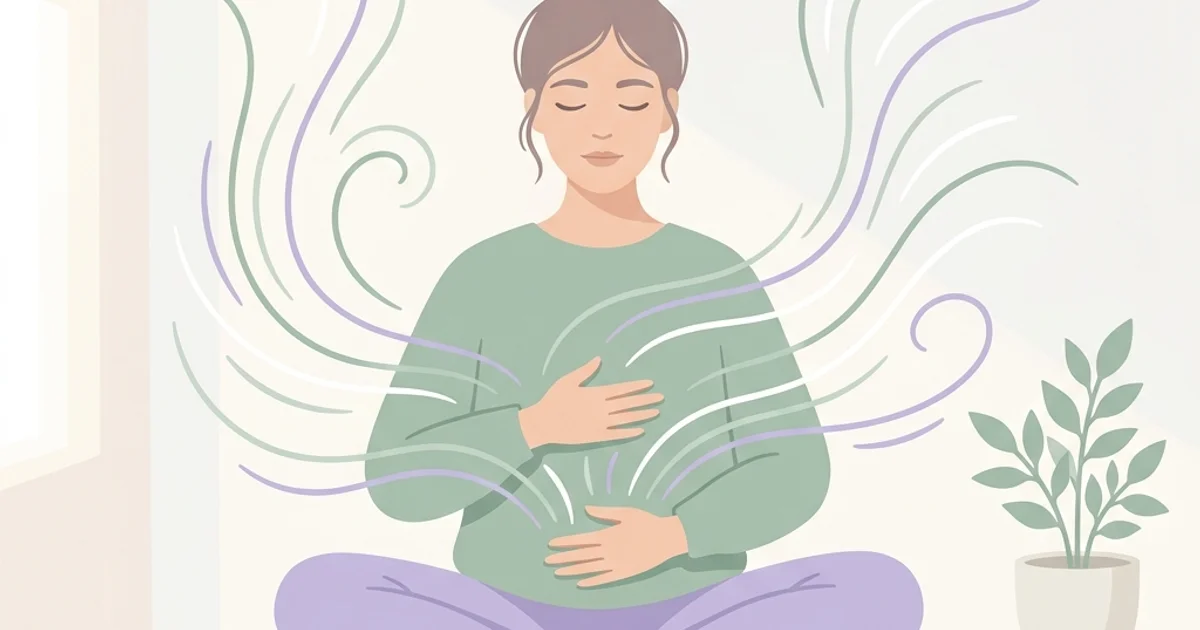
Diaphragmatic breathing is one of the most studied and accessible techniques for reducing everyday stress. Unlike the shallow breathing that dominates moments of tension, it involves expanding the abdomen and activating the parasympathetic nervous system, producing physiological calm in just a few minutes. Systematic reviews confirm its effects on cortisol, heart rate, and anxiety. Best of all: it costs nothing and can be done anywhere.
What is diaphragmatic breathing and how does it work
Diaphragmatic breathing is a technique in which the diaphragm — the dome-shaped muscle below the lungs — is the primary driver of inhalation, expanding the abdomen rather than the chest. Hamasaki (2020) explains that this form of breathing increases tidal volume and activates the vagus nerve, the main pathway of the parasympathetic nervous system.[2] When the parasympathetic dominates, heart rate slows, blood pressure drops, and cortisol production is reduced. Slow breathing — ideally 6 cycles per minute — maximizes this effect by synchronizing breath with cardiac rhythm. Levvi's Health Hub lets you track heart rate variability (HRV), which tends to improve with regular diaphragmatic breathing practice.
Scientific evidence on stress and anxiety
Diaphragmatic breathing has robust scientific backing for stress reduction, with multiple systematic reviews confirming its benefits. Hopper et al. (2019) analyzed studies with healthy and clinical adults and concluded that the technique significantly reduces both physiological stress (cortisol, blood pressure) and psychological stress (anxiety, perceived tension).[1] Bentley et al. (2023) proposed evidence-based implementation guidelines recommending sessions of 5 to 10 minutes, 1 to 3 times per day, over 4 to 8 weeks for sustained results.[3] Effects are noticeable in the very first session, but consistency amplifies the benefits. Levvi makes consistency easier with recurring tasks and daily reminders for breathing breaks.
Slow breathing and the autonomic nervous system
Slow, deep breathing acts like a switch for the autonomic nervous system — turning off "fight or flight" and activating "rest and digest." Banushi et al. (2023) reviewed breathing interventions in people with diagnosed anxiety disorders and found clinically significant reductions in symptoms.[4] The core mechanism involves the vagus nerve: prolonged exhalation stimulates baroreceptors in the aortic arch, which signal the brain to lower heart rate. A 1:2 ratio between inhalation and exhalation — for example, 4 seconds inhaling and 8 seconds exhaling — is especially effective. Hamasaki (2020) adds that regular practice improves HRV by 15% to 20%.[2] Levvi's energy modes can suggest breathing exercises as a priority self-care activity on low-energy days.
Beyond stress: other documented benefits
Diaphragmatic breathing delivers benefits beyond stress relief, impacting sleep, digestion, and even blood sugar control. Hamasaki (2020) documented improvements in sleep quality, reductions in functional gastrointestinal symptoms, and support in managing chronic pain.[2] Studies with diabetic patients showed reductions in glycated hemoglobin levels after 12 weeks of daily practice. Slow breathing also improves lung capacity and tissue oxygenation. Bentley et al. (2023) highlight that the technique has no known side effects, unlike anxiolytic medications.[3] In Levvi, the self-care module lets you log breathing practice as part of your routine, tracking consistency week after week.
How to practice: a quick evidence-based guide
Practicing diaphragmatic breathing requires only a quiet spot and 5 minutes — no equipment needed. Sit comfortably or lie down with one hand on your chest and one on your abdomen. Inhale through your nose for 4 seconds, feeling your abdomen rise (the hand on your chest should stay still). Exhale through your mouth for 6 to 8 seconds, gently contracting your abdomen. Repeat for 5 to 10 minutes. Bentley et al. (2023) recommend 1 to 3 daily sessions, preferably at fixed times, to build consistency.[3] Levvi lets you create tasks with a scheduled time for these breathing breaks, integrating the practice into your routine sustainably.
Conclusion
Diaphragmatic breathing is a powerful scientific tool hidden inside a gesture we do all the time: breathing. Just five minutes a day produces measurable effects on cortisol, heart rate, and anxiety. It requires no equipment, has no side effects, and can be practiced at any moment. The challenge isn't starting — it's remembering to do it.