
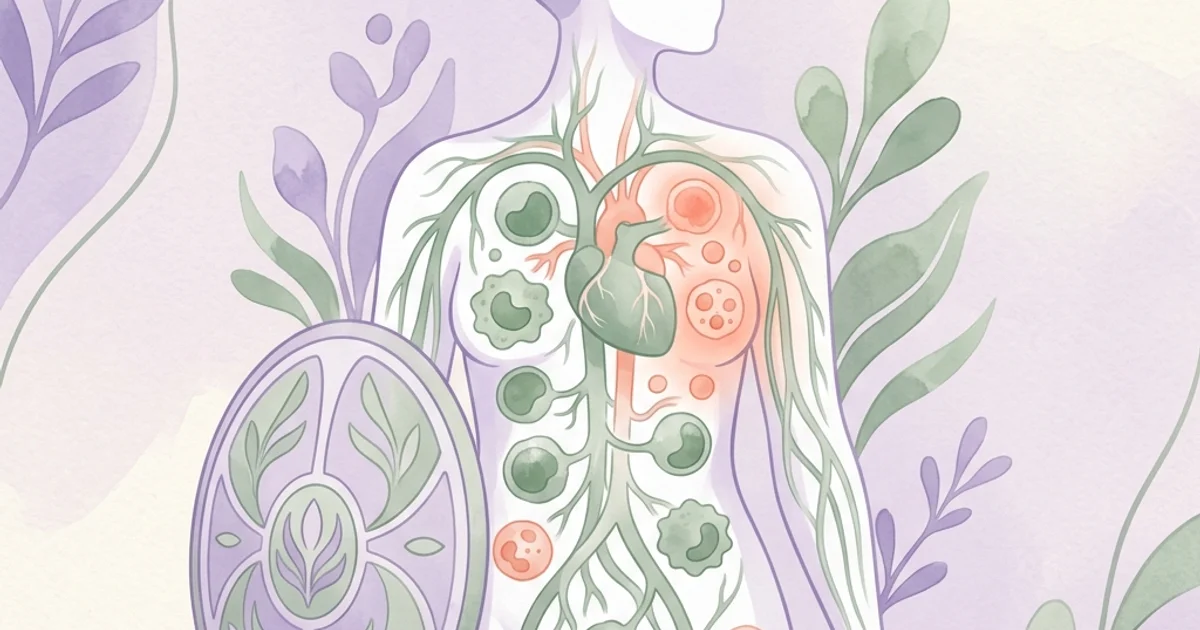
Autoimmune diseases affect women disproportionately: they represent about 80% of diagnosed cases. Lupus, rheumatoid arthritis, multiple sclerosis, and Hashimoto's thyroiditis are just a few of the more than 80 conditions in which the immune system attacks the body's own tissues. This article explains what science knows about this disproportion and how Levvi can help women living with autoimmune conditions monitor symptoms and adapt their routine.
The female immune system is stronger and more reactive
Women have more robust immune responses than men to both infections and vaccines — an evolutionary advantage. But that same elevated reactivity increases the risk of the immune system attacking healthy tissue. A 2018 review in Frontiers in Immunology explains that estrogen is a potent stimulator of adaptive immunity, activating antibody-producing B cells.[1]
Androgens, predominant in men, exert a protective effect against autoimmunity. This hormonal difference partly explains why conditions like lupus affect 9 women for every man. Levvi lets you monitor energy and wellbeing throughout your cycle — information that matters for understanding how hormonal fluctuations impact autoimmune symptoms.
The role of the X chromosome and epigenetics
The sex disparity cannot be explained by hormones alone. A 2024 review in the Journal of Clinical Investigation details how the X chromosome, present in double dose in women, contains more immune-related genes than any other chromosome. Although one X is normally inactivated, that inactivation is incomplete: roughly 15% to 25% of genes escape silencing.[2]
This means women can express higher levels of immune-response genes like TLR7, a receptor that recognizes viral RNA. Epigenetic factors — including modifications influenced by estrogen — and microRNAs carried by extracellular vesicles also contribute to the distinct immune regulation in women. Levvi helps you log symptom patterns that can be shared with your doctor for more personalized management.
How the menstrual cycle modulates immunity
The menstrual cycle is a natural window for observing how hormones modulate the immune system. A 2012 review in Autoimmunity Reviews describes significant fluctuations in immune cells across all 4 weeks of the cycle. Regulatory T cells, responsible for curbing excessive responses, vary in concentration as estrogen and progesterone levels shift.[3]
Many women with rheumatoid arthritis, lupus, or multiple sclerosis report worsening symptoms during specific cycle phases, especially the luteal phase and during menstruation. Logging symptoms by phase in Levvi can reveal these patterns, providing concrete data to adjust treatments and routines throughout the month.
Lupus, rheumatoid arthritis, and multiple sclerosis: the most unequal trio
Three autoimmune diseases illustrate the sex disparity with particular clarity. Systemic lupus erythematosus affects 9 women for every man, with incidence peaks during reproductive years. Rheumatoid arthritis is 2 to 3 times more common in women. Multiple sclerosis has a 3-to-1 ratio, and its incidence in women has been rising over recent decades.[4]
The review by Ortona et al. (2016) highlights that pregnancy can modulate these conditions: rheumatoid arthritis tends to improve during gestation and worsen postpartum, while lupus may flare. These variations reinforce the central role of hormones in regulating autoimmunity. For those living with these conditions, adapting your daily routine to your energy level using Levvi's energy modes is a practical way to manage each day.
Conclusion
The female predominance in autoimmune diseases results from a complex interplay of hormones, X-chromosome genetics, and epigenetic factors. Understanding this biology is more than scientific curiosity — it is a tool for more informed care. Monitoring symptoms, energy, and cycle patterns in Levvi helps women with autoimmune conditions identify triggers and adapt their routine. Specialized medical follow-up remains the most important step.