
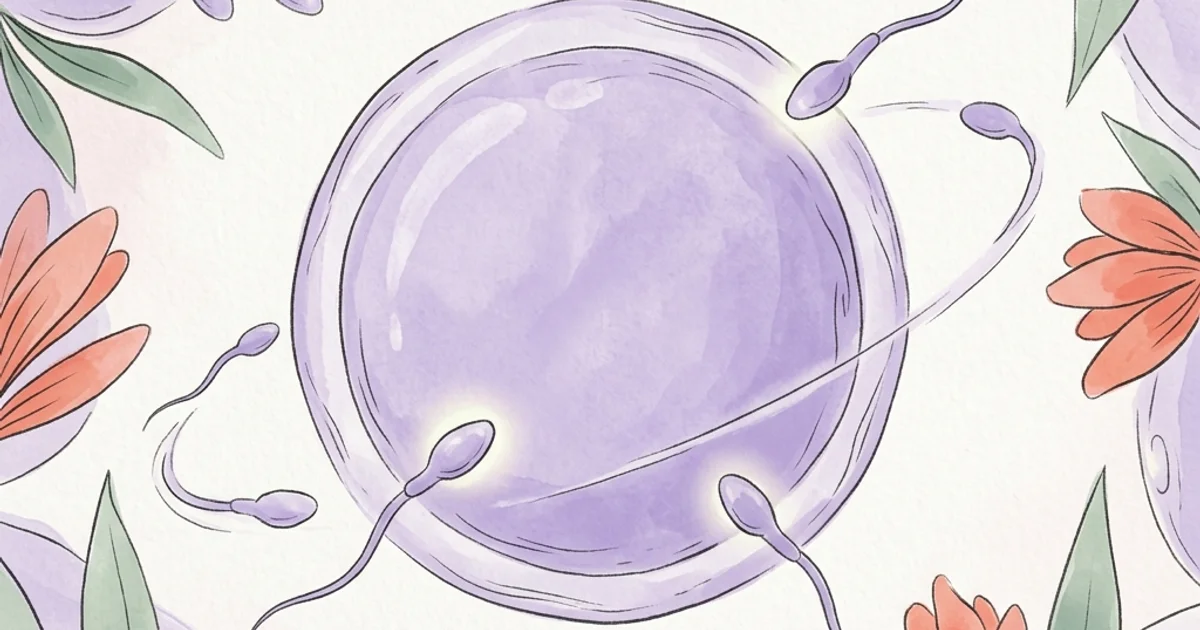
If your partner is trying to conceive, you are not a bystander. Human fertilization involves two sides — and your role begins well before intercourse. Understanding how the egg works, when it is available, and what sperm need to reach it is the first step to stop acting in the dark.
The Fertile Window: Smaller Than You Think
A woman's fertile window spans just 6 days per cycle. Not a vague two-week period — a precise window made up of the 5 days before ovulation plus ovulation day itself. Data from 225,596 menstrual cycles confirm that conception probability peaks in the 2 days before ovulation, not on the exact day.[1] The reason is biology: the egg survives only 12 to 24 hours after release from the ovary. If no sperm is waiting — or arriving quickly — during that interval, the chance drops to zero. There is no recovering a missed day within the same cycle. Levvi tracks your partner's cycle and alerts you when the window is opening, so you never have to do the math under pressure.
The Egg: 24 Hours to Act
The egg is the largest cell in the human body — and one of the most short-lived. After ovulation, it travels through the fallopian tube toward the uterus. Fertilization must happen along this path. The egg is viable for a maximum of 24 hours. After that, it degenerates and the cycle resets. Mathematical models built over 30 years to estimate day-by-day conception probability confirm that this post-ovulation window is the real bottleneck in human fertilization.[4] The correct logic is not "sex on ovulation day" — it is "sperm already present when ovulation occurs." Arriving before is biologically superior to arriving exactly on time.
Sperm Survival Depends on the Environment
Sperm can survive up to 5 days in the female reproductive tract — but that number depends on one critical condition: favorable cervical mucus. Outside the fertile period, cervical mucus is thick, acidic, and impenetrable: sperm survive less than 2 hours in that environment.[6] In the days around ovulation, under estrogen influence, mucus changes texture: it becomes fluid, elastic, and transparent — resembling raw egg white. In this state, it protects sperm, neutralizes acidity, and creates channels that allow movement toward the fallopian tubes. This is why the fertile window exists: not just the egg changes — the entire internal environment does.
How Male Age Affects Fertilization
Male fertility declines with age — and the link to cervical mucus is direct. A study of 782 couples across 7 European family planning centers found that men over 35 have up to 50% lower conception odds on days without visible cervical mucus, compared to younger men.[3] As mucus becomes more favorable, that gap narrows: it drops to 21% on wet secretion days, 11% with thick mucus, and only 4% on egg-white mucus days. Cervical mucus is not just a passive marker of female fertility — it actively compensates for declining sperm quality with age. Knowing when favorable mucus is present through cycle tracking gives any man a real practical advantage.
How Conception Probability Shifts Across the Cycle
A retrospective analysis of spontaneous pregnancies found that peak conception probability occurs around day 12 after the start of menstruation — but that is a population average.[2] The menstrual cycle varies significantly between women and between cycles of the same woman: the follicular phase can last 10 to 21 days, while the luteal phase is more stable at 12 to 14 days. Calculating the fertile window by the "day 14 rule" is inaccurate for most women. Levvi solves this by tracking your partner's individual cycle over months, adjusting predictions based on real personal history — not population averages.
What Male Lifestyle Has to Do With It
Sperm quality — count, motility, morphology, and DNA integrity — is directly shaped by lifestyle. A 2024 review found that obesity, smoking, alcohol consumption, chronic stress, and radiation exposure measurably reduce male fertility.[5] Sperm production takes 72 to 90 days — meaning habit changes made today affect sperm quality 3 months from now. Reducing alcohol, quitting smoking, exercising moderately, and maintaining a healthy weight all have solid scientific backing. Elevated scrotal temperature — from tight pants, hot baths, or a laptop on the lap — also impairs spermatogenesis.
Intercourse Frequency: An Evidence-Based Strategy
The most effective approach is neither "sex every fertile day" nor "saving it for the right moment." Evidence points to intercourse every 1 to 2 days during the fertile window as the optimal balance — frequent enough to keep fresh sperm present in the reproductive tract, without reducing count to the point of compromising quality. Daily intercourse over extended periods can lower sperm concentration in men with borderline counts. Gaps greater than 4 to 5 days tend to include a higher proportion of aged sperm with more DNA damage.[1] Levvi's Health Stories shows which cycle phase your partner is in, in real time — letting you align this strategy without unnecessary pressure.
The Fertilization Process: What Happens Inside
After ejaculation, sperm travel roughly 18 centimeters — from the cervix to the fallopian tube — through an environment full of immune barriers. Of the millions of sperm in a single ejaculation, only a few hundred reach the vicinity of the egg. One sperm penetrates the zona pellucida — the egg's protective membrane — triggering an immediate chemical reaction that blocks all others from entering. The 23 paternal chromosomes then fuse with the 23 maternal chromosomes, forming a zygote with 46 chromosomes. This process takes around 12 to 24 hours. Over the following 5 to 6 days, the embryo divides and migrates through the uterus until implanting in the endometrium — completing conception.
What to Do Starting Now
Your role in conception has two practical dimensions. The first is timing: knowing when the fertile window is open and ensuring intercourse in the 2 to 3 days before ovulation. The second is quality: investing the next 90 days in adequate sleep, anti-inflammatory nutrition, regular exercise, and reducing alcohol and smoking — enough time for a full new sperm production cycle.[5] Cycle tracking is not exclusively your partner's job. It is a couple's tool — and Levvi was designed to make that partnership simple and low-effort.